_edited.png)
The Tantra–Meditation Connection: Awareness, Practice, and the Path to Awakening

Most of us have some relationship with the word tantra — even if what we carry is more myth than understanding. It moves through popular culture as something exotic or transgressive, rarely landing close to what the tradition actually is: a complete science of consciousness, a living map of the inner world, a path that does not ask you to leave ordinary life behind but to wake up within it.
Meditation is at the centre of this path. Of all the tantrik tools, it is the most important — and it is also, perhaps, the most frequently mischaracterized. Tantric meditation is not the same as the meditation you might encounter in a wellness app or a hospital stress reduction program. It includes movement, colour, and sound. It works with the body as much as the mind. And its ultimate orientation is recognition — the direct knowing of what you already and always are.
This post offers a map of the foundational teachings that underlie tantric meditation practice: the five states of awareness that the tradition identifies, the five layers of the self through which a practitioner moves, the classical tools that support the path, and the benefits — physical, emotional, mental, and spiritual — that arise from sustained sādhana. Whether you are encountering these teachings for the first time or returning to them with years of practice behind you, we hope this serves as useful orientation.

Awareness: The Heart of Tantric Meditation
Awareness is the central concept in tantrik practice. In an everyday sense, awareness describes how you perceive what is happening within and around you. In tantra, however, the words Awareness or Absolute Awareness point to something far more fundamental — the very essence of your being, that which is both beyond material existence and the very source of it.
Tantric meditation, in all its forms, is a means of moving toward this recognition. It provides access to the full spectrum of awareness states, from the most ordinary and surface-level to the most refined and luminous.
The Five States of Awareness
It is commonly understood that there are three fundamental states of awareness we move through each day: the waking state, the dream state, and the deep sleep state. The ancient Vedic text Māṇḍūkya Upaniṣad acknowledges all of these states, plus a fourth state known as turīya — a state of Pure Consciousness that transcends the first three. Tantra goes further still, identifying a fifth state called turīyātīta, which is both beyond and permeating all the others. Understanding these five states is foundational to any serious study of tantra yoga or tantric meditation practice.
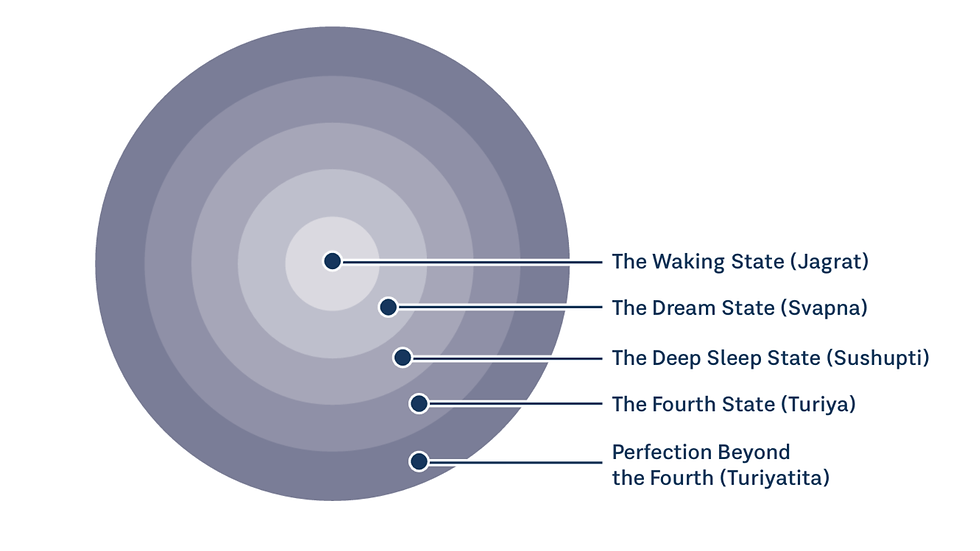
The Waking State (Jāgrat)
Jāgrat is the ordinary waking state in which most of us spend the majority of our lives. In this state, we go about everyday activities and perceive the world primarily through the five senses (jñānendriyas) of the physical body (annamaya kośa). For most people, jāgrat is the most familiar and comfortable form of awareness and yet, it is also the most limited.
In the waking state, Absolute Awareness has crystallized into an individual self that unconsciously mistakes its perceptions of the material world — both outer and inner, including thoughts and emotions — for the whole of its identity. We take ourselves to be a particular person, with a particular story, navigating a particular life. Tantra does not deny this experience; it simply recognizes that it is only partial. Jāgrat is associated with the physical body (annamaya kośa), the energetic body (prāṇamaya kośa), and with tamas guṇa.
The Dream State (Svapna)
When we sleep, we enter svapna, the dream state, during which the five senses are suspended. Awareness travels inward, settling in the mental-emotional body (manomaya kośa). Here, we exercise our capacity for imaginative mental representation, no longer bound by the desires of the five senses but instead under the influence of inner forces: will (citta), egoism (ahaṃkāra), reason (buddhi), and mind (manas).
Most people enter and exit svapna unconsciously, but the experienced tantrik practitioner can move through it with increasing lucidity. Svapna is also connected to the body of higher intellect (vijñānamaya kośa), as our dreams can reflect a wisdom that reaches beyond ordinary desire and habit.
The Deep Sleep State (Suṣupti)
In suṣupti, the deep sleep state, the two previous states merge. There are no objects, experiences, concepts, or sense of time. With nothing left to perceive, we rest in the immensity of our own being. Many compare suṣupti to the meditative state of samādhi, in which the jīva is absorbed in Absolute Awareness. In both, the dreamer rests in the depths of the Heart. The difference is this: in deep sleep there is only ignorance, and so the jīva simply forgets itself and receives the passive benefits of rest. In samādhi, there is awareness, and the bliss of one's Being can be consciously enjoyed. Suṣupti is associated with the bliss body (ānandamaya kośa) and sattva guṇa.
The Fourth State (Turīya)
Turīya, the fourth state, both transcends and pervades the waking, dream, and deep sleep states. While ultimately beyond words, it can be loosely defined as Absolute Awareness itself — the recognition of the True Self that is not available in any of the first three states taken alone. Turīya can be experienced through meditation, ritual, or any sincere spiritual practice.
Because turīya pervades the first three states, it can be realized while still in any of them.
In the waking state, turīya means the jīva no longer identifies with the senses and their objects, resting instead as a pure witness — peaceful and content regardless of external circumstance. In the dream state, turīya is recognized in lucid dreaming, where one "wakes up" within the dream and recognizes that the influences of the mind no longer hold complete authority. And in the deep sleep state, turīya is the basis of Yoga Nidrā — yogic sleep — a state of conscious awareness between waking and sleeping in which the mind and body are laid to rest while awareness itself remains awake, recognizing itself beyond the localized experience of the jīva.
When experienced in its pure form, turīya is comparable to nirvikalpa samādhi — a transcendental state of awareness without subject or object. Pure turīya is realized through the persistent withdrawal of the senses and deep focusing of the mind. It is soundless in the absence of the senses, fearless in the nonexistence of mind, and, as the Māṇḍūkya Upaniṣad states, utterly inexpressible in words.
When a person rests in turīya in any state, there is no desire and therefore a cessation of suffering. A sense of Unitary Consciousness arises.
Perfection Beyond the Fourth (Turīyātīta)
Tantra teaches that there is a state "beyond the fourth" known as turīyātīta. It is helpful to think of turīyātīta not as a fifth state sitting atop a hierarchy, but rather as the complete permeation of the first three states by the fourth, until there is no longer any division between them. In turīyātīta, Ultimate Reality is revealed and the entire universe appears as Absolute Awareness. With this realized, the tantrika knows that there are not three or four or even five states of awareness — there is only one. Final liberation and full awakening ensue.
This fully embodied, undivided Awareness is what is most distinctive about tantra as a path. Unlike traditions that aim primarily to transcend the world, tantric yoga seeks to awaken to Absolute Awareness within everyday life. One who has realized this undivided reality does not appear sublime or otherworldly; they are instead entirely ordinary, because their realization is grounded, embodied, and genuinely natural.
The Five Layers of the Self (Kośas)
In addition to moving through different states of awareness, tantric practitioners also advance through the five layers of self that surround the soul, known as the kośas. These five sheaths are dimensions of experience to be purified, integrated, and illumined.
The outermost layer is the physical body, annamaya kośa — the densest sheath, the one most familiar to ordinary perception. A feeling of deep relaxation in meditation often signals engagement with this layer. Within it sits prāṇamaya kośa, the energetic body — the layer engaged through mantras, yantras, and Kuṇḍalinī practices. Deeper still is manomaya kośa, the mental-emotional body, which focuses the mind and cultivates the capacity to observe thoughts and emotions with calm clarity rather than being swept away by them.
As practice matures, one begins to embody vijñānamaya kośa, the body of higher intellect — the layer associated with discernment, intuition, and inner wisdom. And at the innermost level of the manifest self is ānandamaya kośa, the bliss body, where the cultivation of deep inner contentment becomes a stable, living reality rather than a passing experience.
Tantric meditation works across all five of these layers simultaneously, which is part of what makes it such a comprehensive and transformative path.
Tantrik Tools: The Instruments of Practice
Tantrik practice involves a number of tools. In fact, many Tantrik masters consider themselves scientists and use various tools to obtain certain effects among those who study with them. These effects vary based on the practitioner's intent and can include physical manifestations of good health, life changes, and energetic and emotional shifts. However, the highest objective of the use of Tantrik tools is to connect to specific energy currents (Śakti) to receive Kuṇḍalinī awakening. These tools must always be approached with the utmost respect and reverence.
Āsana refers not only to the physical postures of yoga but also to the simple, stable seated posture used for tantric meditation. Sitting directly on the ground without back support amplifies the benefits of practice and supports the upward flow of prāṇa through the energy centers. In tantra yoga, the āsana mat itself becomes a sacred object — built up through repetitive use until it develops a psychosomatic and energetic influence, helping the body and mind slip naturally into a meditative state.
Mudrā — gesture — recognizes that every movement of the body generates a specific energetic effect. Through the intentional use of hand gestures, bodily positions, and mental states, the practitioner awakens and directs the energies of the chakras. Mudrā appears across Hindu Tantra, Tantrik Buddhism, and classical yoga.
Mantra is among the most powerful of all tantrik tools. A mantra is a series of sacred sounds or words repeated to support and deepen meditation. Sanskrit mantras are particularly potent because each letter of the Sanskrit alphabet corresponds with an aspect of a specific chakra. Mantras received directly from a guru as part of dīkṣā — initiation — carry an additional charge, impregnated with Śakti through the guru's intention and grace. Whether received through initiation or taken up independently, mantras awaken the divine aspects of the Universe that exist within the practitioner, and must be recited with proper svara (rhythm) and varṇa (sound), accompanied by japa (internal repetition), dhāraṇā (concentration), āsana (steadiness), and bhāvanā (devotion).
Yantra is a symbolic diagram of the Divine — not a literal representation of a deity but a geometric form that helps connect the practitioner with specific energy currents while subduing negative qualities and suffering. Yantras may be worn as amulets, kept in the home for protection, or constructed through elaborate ritual to embody the presence of a particular deity.
Āyurveda — the ancient healing science — is integrated into tantrik practice as a preparatory and supportive measure. A guru may prescribe dietary changes, herbal treatments, or lifestyle modifications to prepare the body to receive and hold the energies activated through sādhana.
Yajña — ritual fire offering — is considered by many tantrikas to be the most potent of all tantrik rituals. It combines the creation and empowerment of a yantra with mantra recitation and sacred offerings (samagri) in a fire ceremony, establishing the conditions necessary to receive the highest blessings. Yajña harmonizes the microcosm — the practitioner — with the power of the cosmos.
Kuṇḍalinī: The Innermost Purpose
All of these tools ultimately serve a single supreme objective: to awaken Kuṇḍalinī Śakti. According to the science of tantra, the human being is a mini-universe — all that exists in the cosmos exists within the individual. The entire universe is a manifestation of Pure Awareness, conceptualized in tantra as two aspects: Śiva, the unchanging, unmanifest ground of being, and Śakti, the creative force that brings forth the entire manifest world.
Within the body, an aspect of Śakti lies dormant at the base of the spine. This is Kuṇḍalinī Śakti — the essence of the Goddess's grace. When this energy awakens, it generates an ascending movement through the chakras to the sahasrāra (crown) chakra, the abode of Śiva. This union of Kuṇḍalinī Śakti with the crown ignites Cosmic Consciousness — the living realization of non-dual Absolute Awareness.
The Benefits of Tantric Meditation Practice
Physical Benefits
When tantric meditation draws the practitioner into deeper states of awareness, the body engages the parasympathetic nervous system. In this state, digestion, emotional processing, and physical healing are all supported. Regular meditative practice alone provides substantial physical benefit — though these effects are not unique to tantra. What is distinctive to tantric meditation is the purification and revitalization of the nāḍīs, the subtle energy pathways of the body. When these channels are cleaned, aligned, and awakened, the physical body is harmoniously restructured from within. This process is further supported when āyurvedic healing is brought into the tantrik practice.
Emotional Benefits
Tantra and yoga both hold that the physical influences the emotional and vice versa — when the body is balanced, the emotions are balanced. Through steady tantrik practice, emotional issues can lessen. Intense emotional outbursts will sublimate as the energy lifts to higher chakras. Self-awareness will build, and you will be able to resolve conflicts with love and compassion. Regular practice can help you feel more empowered, confident, and stabilized in your everyday life.
Mental Benefits
Through persistent sādhana, the tumultuous thoughts that tirelessly push us around dissolve, revealing clarity of mind, discernment, and the ability to listen to Truth. Mental purification is one of the most significant stages of the awakening process, because our attachment to the mind and its stories is often the last veil to fall before deeper spiritual realization.
Spiritual Benefits
For most sādhaks, the primary purpose of tantra is spiritual benefit — and when spiritual attainment is the ultimate goal, blessings within the mental, physical, and emotional realms will also occur. Through tantrik sādhana, the chakras become purified and balanced, awakening Kuṇḍalinī Śakti. As the practice deepens, the energy flows into the suṣumnā nāḍī (the central energy channel), rising to the ājñā (third eye) chakra and precipitating a focused and luminous mind. Here, you begin to disidentify with your personality. Once stabilized in the ājñā chakra, Kuṇḍalinī Śakti rises to the crown of the head, where Śiva resides. Here, there is a union of the manifest and the unmanifest, resulting in the last stage of awareness, turīyātīta. Now you will know yourself as Absolute Awareness. You will be liberated from the impressions of the mind and its will, free to truly be of compassionate service to the betterment of the world.
Initiation and the Role of the Guru
In both Śāktism and Śaivism, dīkṣā — initiation — is one of the most significant rituals a tantrika can undergo. The word itself is derived from da ("to give") combined with kṣi ("to destroy"): in dīkṣā, the guru destroys aspects of the ego and mental conditioning in the student, replacing them with Śakti — the spiritual energy necessary to sustain and deepen practice.
To attempt serious tantrik practice without the foundation of dīkṣā is, as the tradition teaches, like trying to start a fire without a flame. It is possible, but significantly more difficult. The guru gives the student the flame of wisdom as a transmission from a living lineage.
Study Tantra Yoga with Anuttara
If something in this post has landed — a question that has opened, a recognition that has stirred, a longing for practice that goes deeper — we invite you to explore what Anuttara offers. Our trainings are rooted in the teachings explored here, held within a living lineage, and transmitted through the grace of dīkṣā — initiation — for practitioners who are ready to go further.


Comments